Triplet-Triplet Annihilation Upconversion (TTA-UC) Research
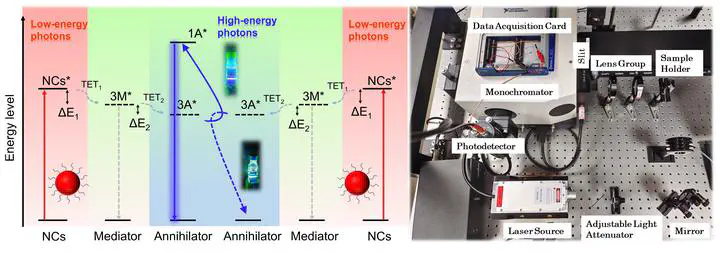
Triplet-triplet annihilation upconversion (TTA-UC) is a promising photophysical process that converts lower-energy photons into higher-energy light. This process typically involves two key components: a sensitizer and an annihilator (or emitter). The sensitizer first absorbs low-energy light (e.g., visible or near-infrared) and populates its triplet excited state via intersystem crossing. Through triplet-triplet energy transfer (TTET), this energy is relayed to the annihilator. When two annihilator molecules in their triplet states encounter each other, they undergo triplet-triplet annihilation (TTA), resulting in one molecule in its singlet excited state and the other returning to the ground state. The excited annihilator then emits upconverted fluorescence at an energy higher than the incident photons. A significant advantage of TTA-UC is its ability to occur at low excitation intensities, such as under non-coherent sunlight or low-power diode lasers, making it highly attractive for practical applications. Our group is dedicated to advancing the field of TTA-UC by developing novel and highly efficient sensitizer systems. such as Quantum Dot (QD) (inorganic quantum dots as robust and tunable sensitizers.) and organic thermally activated delayed fluorescence (TADF) materials. By leveraging these advanced sensitizers, we are pushing the boundaries of upconversion efficiency, particularly for visible and near-infrared-to-visible TTA-UC. We apply our advanced TTA-UC systems to drive a variety of valuable photochemical and photophysical processes, including: Photo-cycloaddition Reactions: Using low-energy light to trigger [4+2] or other cycloadditions for synthetic chemistry and polymer crosslinking. Photo-cleavage Reactions: Activating protecting groups or triggering bond cleavage with deep-penetrating NIR light for controlled release and drug delivery. Photoisomerization: Inducing molecular isomerization processes with upconverted light for applications in molecular switches and actuators. Our research aims to harness the unique capabilities of TTA-UC to solve challenges in solar energy conversion, photodynamic therapy, nanotechnology, and advanced materials synthesis.

Lili Hou 侯丽丽
Professor in School of Precision Instruments and Optoelectronics Engineering
My research interests include photoresponsive molecular switches/motors, photomodulation devices and triplet-triplet annihilation(TTA) upconversion.