Microfluidic synthesis of quantum dots and applications in QLED
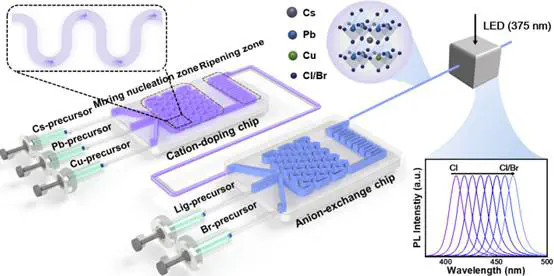
Quantum dots (PQDs) possess outstanding photovoltaic properties, such as high photoluminescence quantum yield (PLQY), narrow full width at half maximum (FWHM), and a wide tuning range of emission spectra from violet light to near-infrared. These characteristics make them highly promising for applications in light-emitting diodes (LEDs), solar cells, photoelectric detection, and lasers. Over the past few decades, the main synthesis methods for quantum dots have mainly been batch reactions, which have poor mass and heat transfer efficiency and are difficult to control and monitor the nucleation dynamics of quantum dots. Microfluidic synthesis methods can precisely control the reaction process by adjusting multiple reaction conditions, which helps to control the size of quantum dots and optimize their growth process, which is crucial for adjusting their optical properties. We designed a series of microfluidic chips with different materials and structures and constructed corresponding microfluidic systems to achieve the synthesis of high-performance quantum dots and apply them to light-emitting devices.

Lili Hou 侯丽丽
Professor in School of Precision Instruments and Optoelectronics Engineering
My research interests include photoresponsive molecular switches/motors, photomodulation devices and triplet-triplet annihilation(TTA) upconversion.